Project case study
WorldKinetics
livePrompt-to-product workspace for customizing physical objects without learning CAD. AI proposes geometry; independent checks bind evidence and approval to the exact revision.
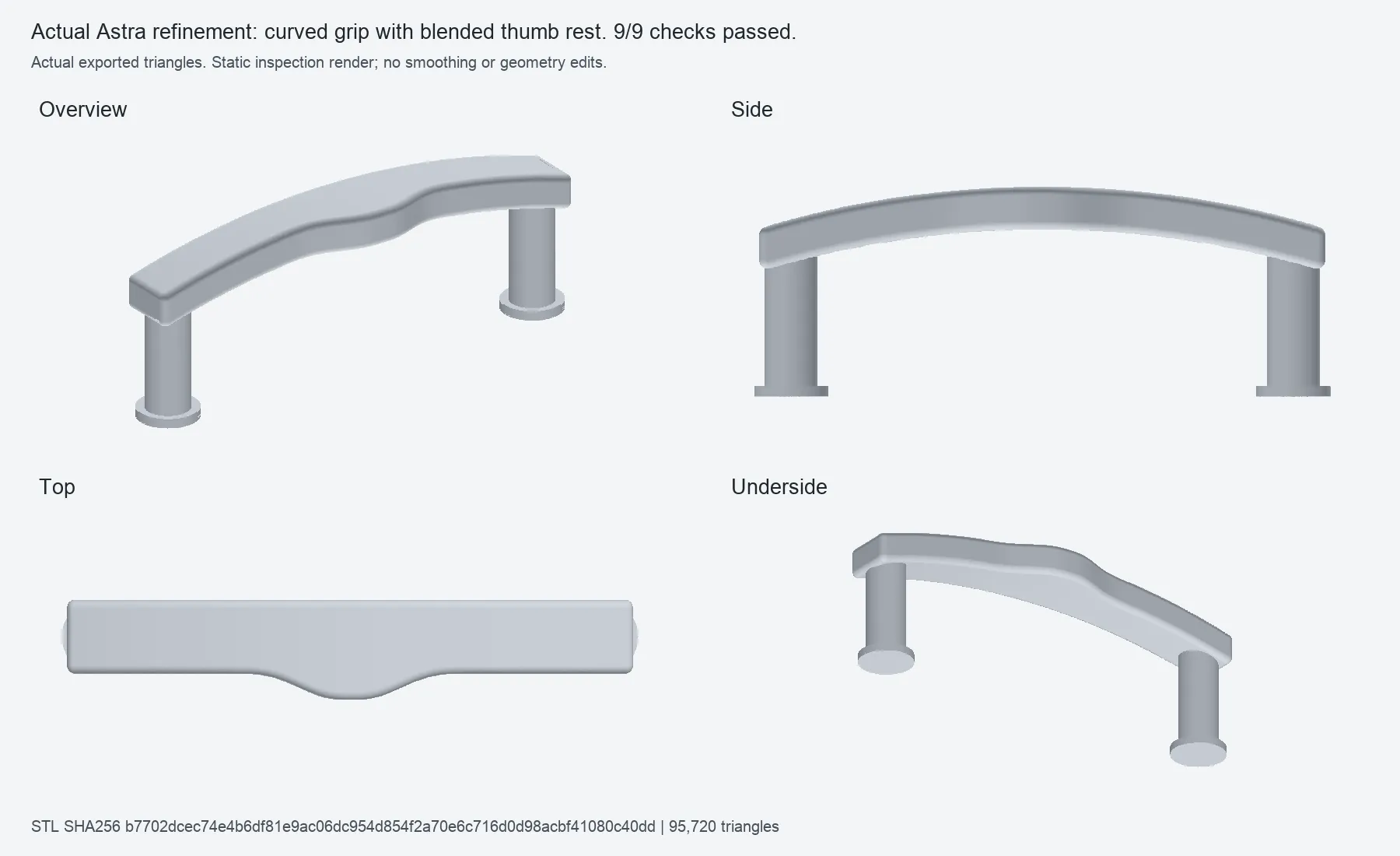
WorldKinetics turns a physical-product change into editable geometry that can be reviewed before a prototype is made. The user describes the goal, confirms the measurements that matter, reviews the generated part and its checks, then approves and downloads the exact revision.
The wedge is guided customization for supported objects, not general-purpose CAD. The first bounded workflow replaces or personalizes a cabinet handle while protecting its mounting interface.
The demonstrated workflow
The recorded handle run starts with three controlled requirements: 96 mm mounting pitch, at least 25 mm of finger clearance, and no more than 140 mm overall length. GPT-6 Astra authored build123d Python for the initial handle and a curved-grip refinement with a blended thumb rest.
The initial design passed eight checks. The refinement passed nine. The accepted result retained the 96 mm mounting pitch, measured 29.568 mm of finger clearance, and measured 110 mm overall. The browser-downloaded STEP, STL, and editable Python matched the accepted manifest.
System design
The model proposes geometry, but it cannot change the checks, lower their thresholds, or approve its own result. Independent application logic verifies the candidate and binds the evidence to a revision, requirements version, and geometry hash. A requirement change invalidates older evidence instead of letting a stale result look current.
- GPT-6 Astra: interprets the request and authors the editable design logic.
- build123d and Open CASCADE: generate solid geometry and STEP/STL exports.
- TypeScript and Zod: enforce the request, revision, evidence, and approval contracts.
- Docker: isolates CAD generation in bounded job directories.
- Three.js: lets the user inspect the actual exported geometry before approval.
- Manifest and prototype package: keep the accepted files, requirements, checks, hashes, and supplier brief together.
What I learned
- A model can own creative variation without owning acceptance. The useful boundary is proposal, deterministic checks, then explicit human approval.
- Evidence must travel with the revision. Measurements from an older candidate are unsafe once geometry or requirements change.
- Controlled dimensions have to stay visible. A polished viewer is not enough if the user cannot see what the system is protecting.
- The workflow continues after download. A useful handoff names the files, units, checks, prototype path, and questions a supplier still has to answer.
- Digital checks are bounded proof. They do not certify physical fit, strength, comfort, printability, or manufacturing readiness.
Current boundary
The public site replays a saved, accepted result and does not generate arbitrary new designs. The demonstrated path is a cabinet handle, not photo-to-CAD or general-purpose modeling. A physical prototype still requires measurement, material selection, manufacturing review, and real-world testing.