Project case study
LoopOS
wipMultiplayer MCP-native agent that replaces the back office for short-term rental operations. Multiple AI clients share one durable backend.
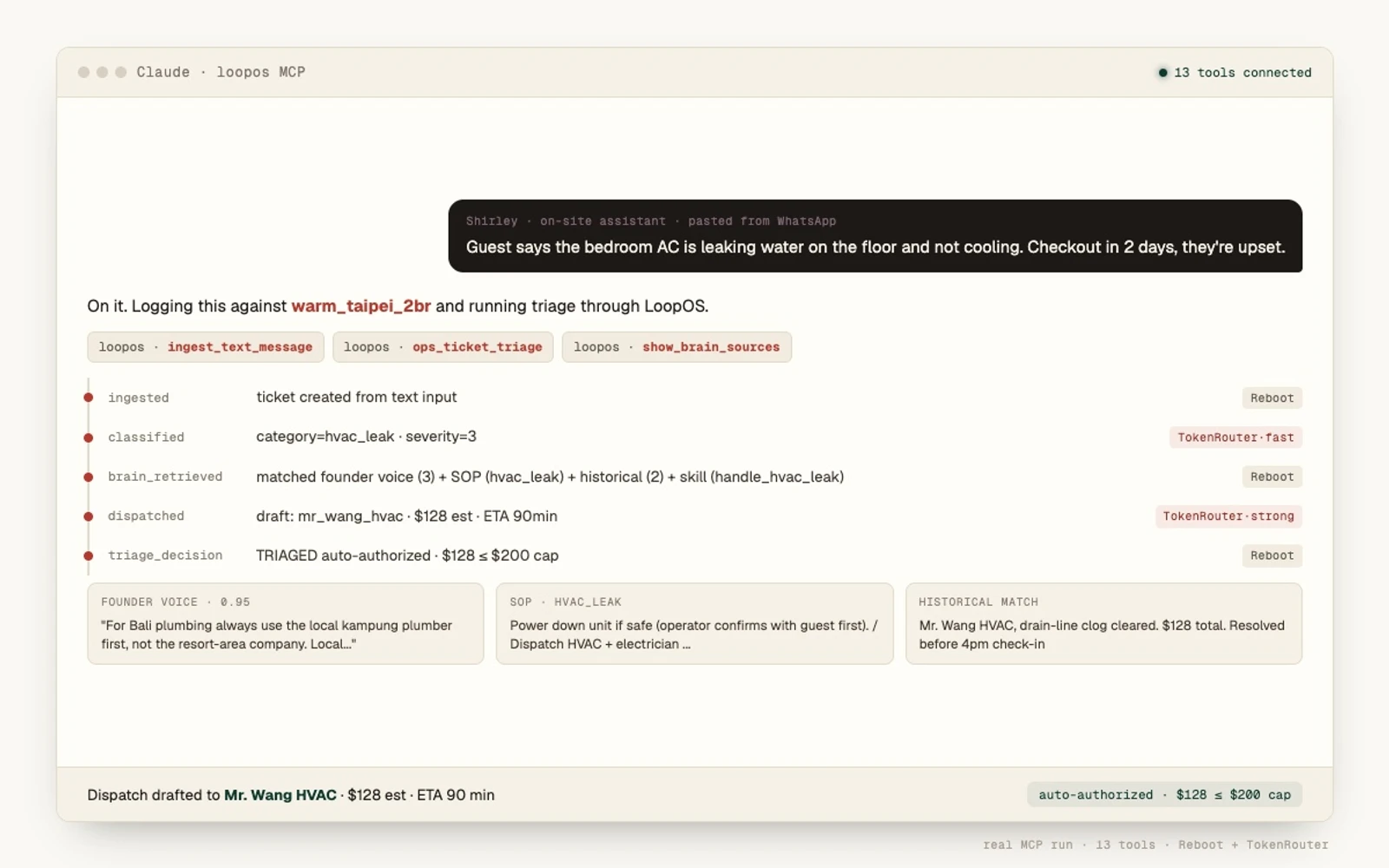
LoopOS is the agent that replaces the back office across five short-term rentals in Japan, Taiwan, Philippines, and Bali. It triages tickets, retrieves the right context from a four-layer Company Brain, drafts the dispatch, and routes it to the right vendor at the right cost cap.
Built initially at AWS Builder Loft “Build YC’s Next Unicorn, Agent Hack Day” (top 6 finalist), it became the ongoing system I use to actually run my STR operations.
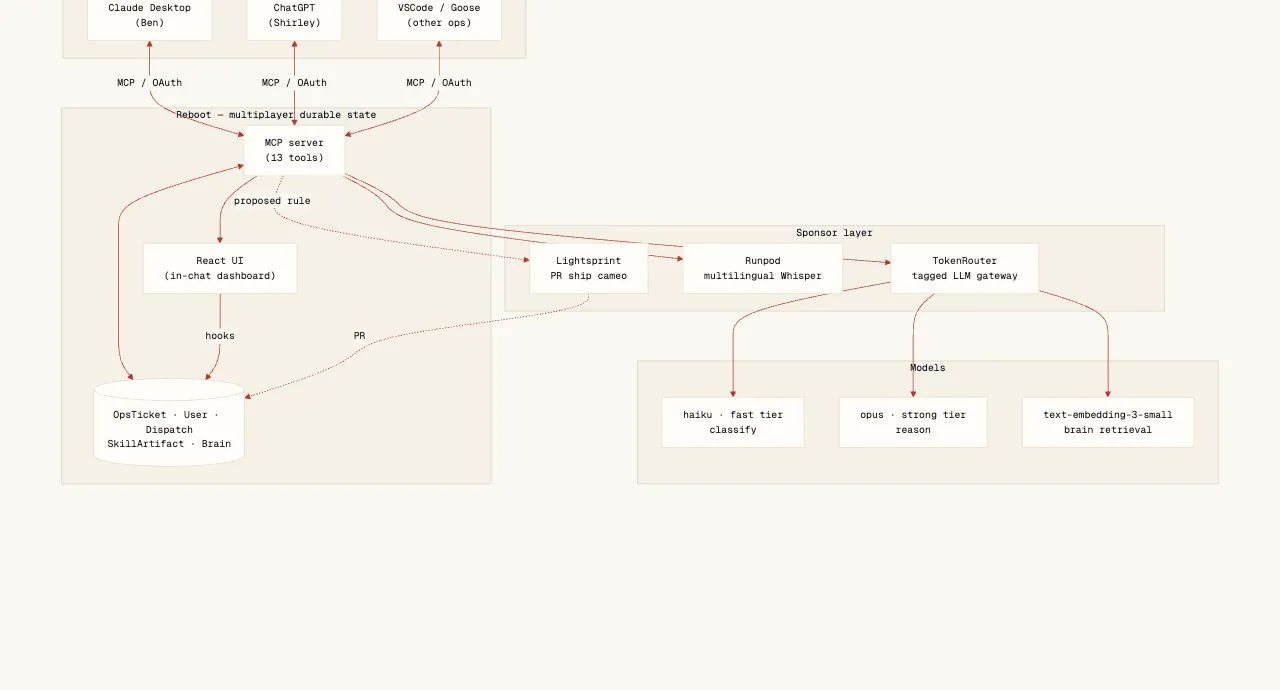
The architecture: a multiplayer MCP-native AI Chat App on Reboot. Every team member’s AI client, Claude Desktop, ChatGPT, Goose, any MCP client, plugs into the same durable backend and shares state. Tickets are first-class entities. Skills are an executable, version-controlled JSON map. The agent runs the map, it does not retrieve over it.
It answers two of the 2026 YC Requests for Startups:
- Alströmer · “Sell the service, not the software.” STR ops back-office spend dwarfs software spend. Replace the back office with an agent; take the margin.
- Blomfield · “Tribal knowledge in heads, email, Slack, tickets.” Build a living, executable map. Four layers, one JSON, the agent runs against it.
Implementation notes
- Reboot. The whole reason LoopOS is “multiplayer”: Reboot gives every connected AI client one durable, shared backend, so a ticket Shirley opens in ChatGPT is the same first-class entity I see in Claude Desktop. The lesson was that durable, multiplayer state changes the unit of work from “a chat session” to “a ticket,” which is what an ops tool actually needs.
- TokenRouter. A tagged LLM gateway that let me run two tiers (a fast tier to classify, a strong tier to reason) and, more usefully, attribute every call’s cost to a specific property. Per-property unit economics turned out to be the difference between a demo and a thing I can actually run a business on.
- Runpod (Whisper). Multilingual voice-note intake: a Mandarin voice memo from an on-site assistant transcribes and translates before triage. The innovative bit is that the messy real-world input (a WhatsApp voice note) becomes a structured ticket with zero human retyping.
- Lightsprint. The rule-evolution cameo: when the agent spots a pattern it proposes a new automation rule, which ships as a PR. The map the agent runs against is version-controlled, so the system gets smarter by code review, not by drifting prompts.